


Bryan Jones has been with Hoffmann Brothers in St. Louis since 2017, but he didn’t start as service manager. When he interviewed, the role was available — and he turned it down. He wanted to earn it first.
“I chose to step into a different position so I could earn trust, build relationships, and truly understand the team before leading it,” he says.
Before joining Hoffmann Brothers, Bryan had spent more than two decades at another company. When the direction there stopped aligning with where he wanted to go, he made a change. He spent the next two and a half years at Hoffmann Brothers working as a project manager, service technician, and assistant service manager — learning the business and the people from the inside before stepping into the role he’d passed on at the start.
His approach to leadership hasn’t changed much since he stepped into the service manager role. He stays close to the work, riding along with technicians, showing up in the field, staying connected to the day-to-day realities of the job.
“I would never ask them to do something I wouldn’t do myself,” he says. “That kind of leadership builds a culture where people want to do the right thing and find a way to win together.”
That philosophy has shaped some of his most meaningful contributions at Hoffmann Brothers. When his assistant manager and field managers raised concerns about the on-call rotation and its impact on work-life balance, Bryan didn’t table the conversation. The team rebuilt the model together — staggering shifts, adjusting staffing, and restructuring coverage so most technicians could finish their day at a consistent time while still meeting customer demand. “It’s not perfect,” Bryan says, “but it works about 80 percent of the time, and that’s a significant win.” In an industry where ACCA has made workforce development a top priority, that kind of creative problem-solving matters beyond one company’s bottom line. Competing for qualified technicians increasingly means competing on quality of life, and service managers who can improve working conditions without sacrificing customer coverage are building something that shows up in retention and recruiting alike.
A similar approach drove real growth in indoor air quality. Duct cleaning had been underperforming, and rather than force a quick turnaround, Bryan focused on developing the people. He gave technicians room to build confidence and take on new challenges at their own pace. Over time, the team expanded its capabilities into filtration, ventilation, and humidity control — growth that held because it came from within the team rather than being pushed onto them.
On the customer side, Bryan operates from a simple conviction: they chose us.
“They could have chosen many other companies,” he says. “Going above and beyond isn’t optional — it’s the standard.”
He backs that up in practice. During a busy Missouri summer, he was heading home when a call came in from a customer whose air conditioning had gone out. He stopped, diagnosed the problem, and got the system running that evening. On a separate occasion, a customer was waiting on a full installation while their failed unit left them without cooling. Bryan delivered and installed a temporary window unit to bridge the gap. Both situations were resolved without escalation and without anyone having to ask twice.
Bryan’s leadership also shows up in moments that have nothing to do with service calls. When a team member was injured on the job, Bryan was the first to arrive. He stayed calm, coordinated the response, personally transported the employee to receive care, and stayed throughout the process to make sure he was supported.
“When something like that happens, nothing else matters in that moment,” he says. “Your people come first.”
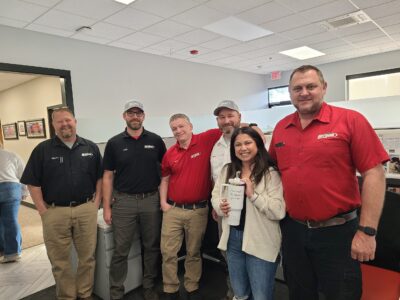
Bryan accepts the Service Manager of the Year award (sponsored by the ACHR News) the same way he talks about his team — by pushing the credit outward. He points to his field professionals, CX and dispatch teams, his assistant manager, and company leadership for building a culture where doing right by the customer is genuinely the expectation.
“This recognition only happens because of the team around me,” he says.
ACCA members can read this article and more in the Spring 2026 edition of ACCA Now Magazine online.
The post A team-first approach earns Bryan Jones ACCA’s 2026 Service Manager of the Year appeared first on ACCA HVAC Blog.