


Before you read any further, assign a percentage of importance to each of the four duct-related factors below. Together they must total 100%. Go with your instincts and write them down before you continue.
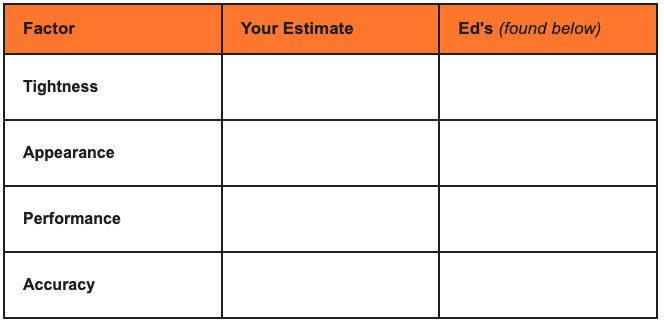
Most experienced installers, technicians, and practitioners answer quickly, and many answer incorrectly. These four factors define the effectiveness of any residential or light commercial duct system, yet they are routinely misunderstood or unevenly prioritized. How you weigh them reveals how well you understand what a duct system is actually supposed to do.
Tight ducts are always preferable to leaky ones. This is non-negotiable. Duct leakage directly degrades system efficiency, raises energy costs, and undermines comfort. Under current energy codes such as IECC 2021, leakage is evaluated against thresholds commonly expressed as total leakage per 100 square feet of conditioned floor area, typically 3 to 4 CFM. Some jurisdictions are lenient when it comes to leakage to the outside while others enforce total leakage (current requirement).
Tightness is one of the more objective metrics in duct evaluation because it is measurable and verifiable through a duct tightness test. That said, a tight system can still perform poorly if design fundamentals are ignored. Tightness is a necessary condition, but it is not a sufficient one on its own.
1. Appearance
Appearance is often the most heavily weighted factor in real-world assessments and the most misleading. Clean lines and symmetrical trunk runs tend to impress homeowners and some inspectors. The instinct to associate a polished installation with quality is understandable. The problem is that it is largely unfounded.
A system can look exceptional while failing to deliver adequate airflow to a single room or through the entire system. Over reliance on appearance almost always signals an absence of deeper technical evaluation. Aesthetics are not a substitute for measurable performance outcomes.
2. Performance
Performance is where a duct system proves its worth. The common benchmark is approximately 400 CFM per ton of cooling capacity. A system that achieves this across its air handler is, by a basic measure, functional. But functional is not the same as optimal.
True performance evaluation must account for proper airflow distribution across all conditioned zones, operating at an acceptable external static pressure and at velocities that are under the maximums in ACCA Manual D® guidance. When performance is evaluated holistically, at every terminal device rather than just at the air handler, it becomes one of the most important and overlooked categories in duct assessment.
3. Accuracy
Accuracy is the factor that separates adequate duct systems from exceptional ones, and it is most often absent from field installations. Accuracy means designing airflow to match the building’s actual load requirements. Using ACCA Manual J® load calculations as the foundation, the practitioner determines the required CFM for each room based on its specific heat gain and heat loss, utilizing the ACCA Manual D® Duct Sizing Worksheet. The target is not a blanket 400 CFM per ton. It is a room-by-room value derived from sensible and latent loads, influenced by glazing, insulation, infiltration, internal gains, and the sensible heat factor of the selected equipment. Required airflow per ton can range from 350 to 450 CFM or more depending on those variables. These specific airflows are in ACCA Manual S®.
Accuracy requires calculations and documentation. It is the domain of ACCA Manual D® duct design executed against ACCA Manual J® load outputs, not intuition or rule-of-thumb shortcuts.
Revisiting your numbers
Go back to the percentages you wrote down. Before you read any further, assign a percentage to each of the four factors below. Together they must total 100%. Go with your instincts and write them down before you continue.
If appearance ranked high, you are overvaluing a factor with no direct bearing on system function. If tightness topped the list, you are prioritizing something important but possibly at the expense of the design work that makes it meaningful. If accuracy was an afterthought, that is the most common and consequential mistake in the industry.
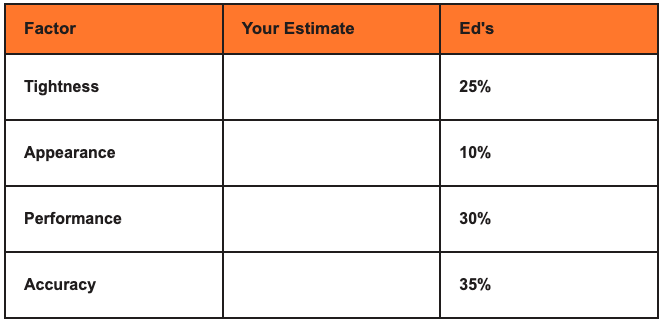
My weighting looks like this: tightness at 25%, appearance at 10%, performance at 30%, and accuracy at 35%. This reflects a shift from superficial evaluation toward measurable, outcome-driven results. There are no correct numbers other than making sure we rely more on performance than appearance.
What you prioritize determines what you build, and what you build determines what your customers experience for the life of that system. The next time you evaluate a duct system, ask yourself whether you are judging what is easy to see or what actually determines whether the system does its job.
ACCA’s Manual J®, Manual S®, and Manual D® exist to answer that question with numbers instead of impressions. Use them.
This article was originally featured in the Summer 2026 edition of ACCA Now Magazine. ACCA members can read the full magazine at https://hvac-blog.acca.org/magazine/.
References: ACCA Manual J® (Residential Load Calculation) and Manual D® (Residential Duct Systems), ANSI-recognized industry standards. Visit acca.org.
The post An observation of ducts appeared first on ACCA HVAC Blog.